

Lessons Learned Elk Hunting in Bear Country
By Steven Burton, Lansing SCI Member and avid hunter
All my hunts start early in the year with the flurry of state tag drawings. I put in every year for Elk and Deer in a handful of western states, New Mexico included. This year I was fortunate to draw an early season NM Elk Archery tag for the dates of September 1-14. Most of my friends like to sit in a hunting blind and wait hours or days for a deer to walk by. Not me. Once I tasted still hunting and spot and stalk, I never looked back. Therefore, I would be doing a solo archery hunt all by myself.
Hunting Elk in New Mexico
I like NM. The best thing about it is it’s the only state that doesn’t have a point system for elk. What that means to non-western hunters is you have an equal chance as everyone else to get drawn for a tag every year. If you look at some states draw odds, you will need to buy a general hunting license and buy a preference point every year until you get selected.
For some states that means not hunting for 5-10 years. In NM you just apply. The second reason NM is my favorite elk state is that there are quality bulls in every unit. I have hunted my selected unit once before and shot a great 5×7 with my bow. My partner on that trip in 2018 killed a 6×7 with his bow. Needless to say, it’s a must apply for state every year.
Scouting for Elk in New Mexico
I got to my unit on day 3 of my drive and started scouting forest service roads looking for hunting pressure. My experience has told me to hunt where no one else is. This usually means finding a road-less area and backpacking in 1-2 hours at a minimum. On this trip I drove the north side of the unit, along the Colorado border for two days and didn’t find what I was looking for. On day three of scouting I drove to the south border of my unit and bingo, I found tall mountains with little access. I knew I would find elk here and after a quick three mile scouting trip I located a honey hole of bull activity at the top of a mountain. I backed out, set up my one person bivy and made a plan for the next morning.
The morning was crisp, clear and I was all alone on the mountain. I had hiked in about 1.5 miles from the nearest road and got to my hunt area right when the sun was breaking the horizon. I set up and sat quietly, listening to the woods for about an hour. I knew elk were close and I contemplated my strategy. I then let out one soft bugle and waited. I knew from experience that the rut was not quite in full swing but wanted to gauge the herd I knew was near. Numerous times I have had bulls come sneaking into my call 20 minutes later, without a sound.
Getting Cold Waiting for a Bull Elk
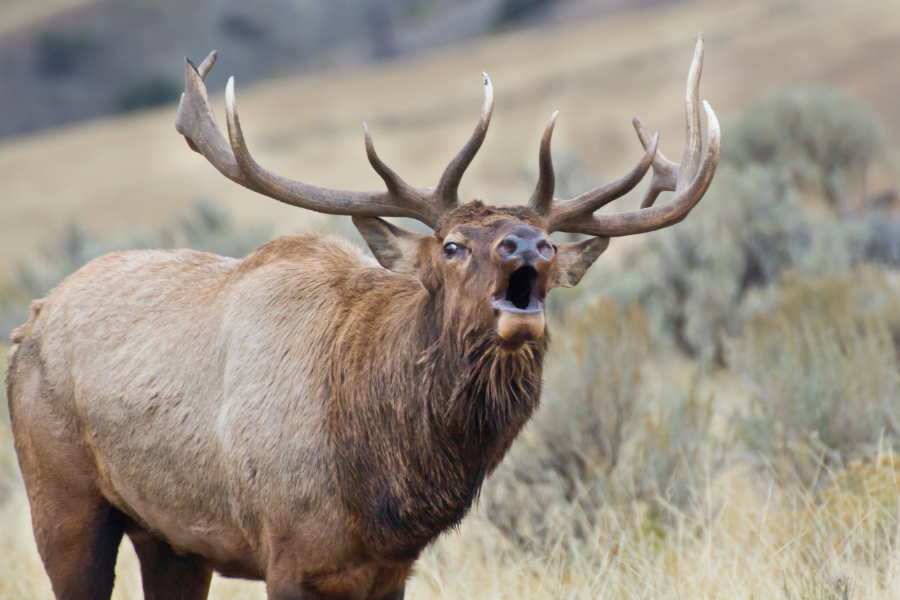
My toes were getting cold. The 40 degree morning came with damp knee high grass that found its way into my supposed waterproof boots. I sat for about twenty minutes, thinking 30 was my limit as I dressed light and would need to move. I then saw movement from the left, an elk, a bull elk, one..two… three. I kept counting until I got to six points on each side.
It came in faster than expected, and by the time I found a shooting lane and ranged it he was already there. My 45-yard shot was rushed and sailed just high, probably due to my shivering. I watched and listened to the bull elk run a large horseshoe and ended up right where he started, about 300 yards from me in thick timber. I heard him gather his harem and walk out of the thicket, away from me until the sound disappeared. Things quieted down and I knew he didn’t know I was there, but was spooked by the sound of the bow and cracking of the arrow overhead. I figured I had another shot at them as I didn’t believe they went far. I found my bloodless arrow, walked his tracks to make sure it was a clean miss then started the stalk towards where they last were heard.
When I Hunt I Move Slow
I covered about 400 yards in an hour and a half and started to smell elk again in the thick timber. I found a spot to set up, that had a shooting lane and sat. The wind was perfect, 15 mph, blowing right in my face. After 30 more minutes of sitting I let out a few cow calls and ended with a light bugle. I readied the bow and waited. 10, 20, 30 minutes and nothing.
I slowly got off my knee, quivered the arrow and took about four steps. There, movement again up ahead. It was dark, not a deer, but a calf elk. I knew mom and the small herd were close so I slowly moved ahead another 10 yards and knocked my arrow. The calf was 50 yards out. No clear shot. I watched it move towards me feeding on the patches of grass under the lodge pole pine forest. Then movement, to my right, a cow elk leading the calf. Both were moving in on me feeding. I had the cow at 40 yards but wanted a closer shot. I waited. 35, 30, her head went behind the tree and I drew. She came out the other side and stopped, nosing the air, and starting to get nervous. I knew this was my chance.
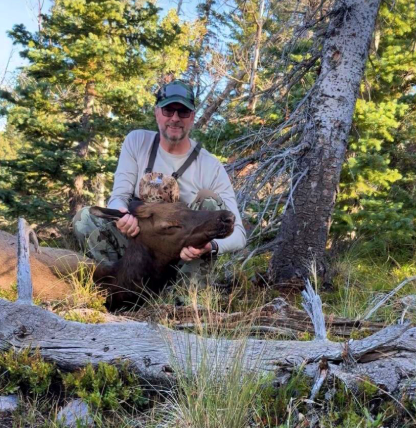
I placed my 30-yard pin on her rib cage and let it fly. Wham, I heard the impact. Perfect shot for a quartering towards elk. She stood there not knowing what had happened. I stood motionless watching as her side turned red with blood. A good hit. She licked at the wound and walked slowly back the way she came. I watched her walk out of sight and knew that was a dead elk.
I waited 30 minutes, started tracking the large amounts of blood and took it slow. After 100 yards, I kicked up the cow and calf, along with three other elk. The wounded cow moved slow, weak, but she had life left in her. I backed out and waited an hour, came back in and took up the track. From where she was bedded, the blood became difficult to detect as the shadows of the evening darkened the forest. About 50 yards into the second try, I kicked her up again.

Elk Have a lot of Blood in Them
If you have never elk hunted, then you might not realize that elk have a lot of blood in them, like gallons of blood. What looked like a good blood trail for a whitetail was really just a slight amount for an elk. My first elk I shot with a bow went almost ½ mile on a lung shot. This one needed more time. So after I kicked her up again, I backed out and was going to give her until morning to expire.
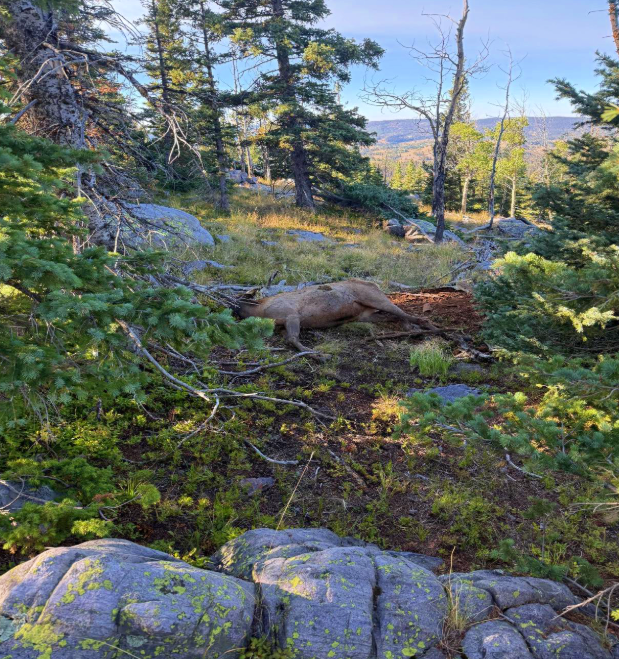
The next morning, I found her about 70 yards from the night before. She was dead. Unfortunately, I wasn’t the only one who found her. I approached the carcass and noted that a huge chunk of the rear hind quarter was missing. I quickly glanced at the carcass and figured coyotes probably got to it. It was disappointing due to the loss of meat I needed to cut off surrounding the scavenged leg.
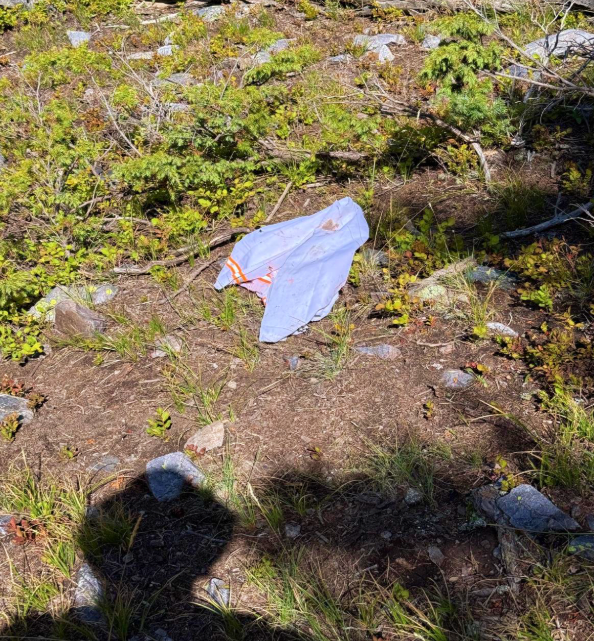
I got right to it and had it quartered and bagged in about an hours’ time. I had three bags of meat; the untouched hind quarter, the two front quarters, and the back straps, tenderloins, and neck. I had a 1.5 mile hike out but it was all downhill so I manned up and took the hind quarter and the other bag of choice cuts. I left the two front shoulders and legs in a double KUIU bag, placed it about 4 feet high on a boulder, out of the way from the carcass and left a few items in my pack as scent to ward off the intruder from the past night.
My pack out was uneventful, took about two hours and I landed at my makeshift bivy site near the road. I am 54 years old so carrying over 100lbs thru the forest wipes me out. I unloaded the heavy pack, made a sandwich and relaxed for about a half hour before heading back up the mountain. When I reached the elevation of 11,500’ I was sucking air, even though my pack was empty. My bow was back at camp and my pack was light as a feather but I could feel the elevation gains in my legs.
Where’s the Meat?
I worked my way through the boulders and came up on the carcass to find my KUIU bags gone. Now, I had heard coyotes in the area that morning so I figured they may have dragged off the meat bag. I searched and could not find any drag marks whatsoever. I went back to the carcass and noted large claw marks on the hide. I started doing circles around the carcass, ever increasing in size, to try and find tracks, drag marks, anything that would show me where the meat was. After an hour of searching, I finally found one empty KUIU bag, with huge teeth marks in it. Definitely not wolves or coyotes.
I searched around for another half hour and finally gave up. Figuring it was a bear or cougar, I was starting to get a little nervous as all I had on me was a .38 with 5 rounds of Plus P ammunition. I went back to the carcass and looked it over one more time. I phoned my son, a Montana Game Warden, and sent him a picture of the carcass and he confirmed it was a bear and not a cat, to my relief. He stated Mountain Lions can’t produce their own iron so when they make a kill, they go right for the iron rich liver of the prey. Always. The liver hadn’t been touched. The bag weighed about 100 pounds so that left only a bear or a man. Finding large teeth marks in the bag confirmed it was a black bear.
Needless to say I was not happy. I don’t know what I would have done if I caught up with the bear holding my $40 KUIU game bag in its mouth but I’m glad we didn’t cross paths. My hour hike-out was pretty easy back to camp. Empty pack, empty game bag, and downhill. A bruised ego and a unique story was all I carried out the second trip.
A Few Lessons for Elk Hunters in Bear Country
First, bring a friend to help with the pack out. That way you can get it out in one haul. Second, hang your remaining meat in a tree. Use a rope and make it inaccessible. Third, and this is important; ALWAYS carry the best cuts of meat out first. Luckily, I managed to do that on my first trip.
All in all, a great hunt and a great story.
Join SCI TODAY!
Safari Club International is the leading voice in the fight to protect the freedom to hunt, both in the United States and internationally. The SCI Departments of Legal Advocacy Resources and International Affairs and Government Relations are headquartered in Washington, D.C., advocating on behalf of SCI members and non-members alike. From staff dedicated to legislation and policy to a team of litigators, SCI hunter advocacy is at the forefront of protecting the hunting heritage. SCI and the SCI Foundation provide the voice of the hunter in treaties that affect hunting and wildlife conservation worldwide. This is where SCI and SCI Foundation go beyond what other hunter organizations do and why their work in this arena is critical to preserving the right to hunt. Plus, we have lots of fun and events like this one!
To find out more information about SCI and join our chapter, click below: